50 Years of Lay Formation in the School of Theology
The story below was originally published in The Athenaeum, MTSM’s bi-annual magazine. The Athenaeum is published twice a year for alumni, patrons and friends of Mount St. Mary’s Seminary & School of Theology. To be added to the mailing list, contact: Heidi Walsh at 513.233.6159 or hwalsh@athenaeum.edu.
By Joey Belleza, STL PhD (Cantab.)
“How can we help serve the Church?”
From this simple question, a new paradigm of faith formation in the Archdiocese of Cincinnati was begun.
Mount Saint Mary’s Seminary in Cincinnati, albeit under different names throughout the years, has been forming priests of Jesus Christ since 1829. First established as St. Francis Xavier Seminary in 1829, it was successively staffed by Vincentians and Jesuits in its early years, before moving to Price Hill under the Mount Saint Mary’s name in 1848. In 1890, the Seminary moved to its current Mount Washington location on the former site of Saint Gregory’s minor seminary, where candidates to Holy Orders from seven dioceses continue their intellectual, human, spiritual and pastoral formation.
In 1975, a former professor of philosophy and theology at the Seminary, Fr. Robert Hater, was serving as a teacher and campus minister at Mount Saint Joseph’s University, then an all-girls institution. This was a time when, invigorated by the Second Vatican Council, members of the laity were awakening to their distinct call to holiness as articulated in the Dogmatic Constitution on the Church Lumen Gentium. On one particularly sunny Saturday, Fr. Hater suggested holding a picnic, at which two Mount Saint Joseph students accompanied him. In the course of their afternoon conversation, ripe with the excitement of those years, one of the young ladies asked Fr. Hater the question mentioned at the beginning of this article, with an important qualification.
“Father, how can we help serve the Church—without becoming nuns?”
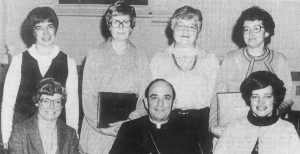
The first graduates from the Lay Ministry Program with then-Archbishop Joseph L. Bernardin in 1978
Upon hearing this question, Fr. Hater realized that there was a real desire among laypersons—young laypersons—to pursue their proper vocation to holiness in the Church, a holiness which is not the preserve of clerics and vowed religious. He witnessed this desire not just at Mount Saint Joseph, but also in many of the local parishes. In short order, he gathered about two dozen Cincinnati Catholics seeking formation for service in the Church, but he had not yet crystallized how to go about this new task, because such an endeavor had never been attempted before. Fr. Hater asked Archbishop (Joseph) Bernardin for help in formulating a response to this vibrant lay impulse. The Archbishop’s response was immediate: “If there’s two dozen of these people now, there will be more, and we have to do something for them. Go talk to Fr. (Raymond) Favret, the Rector of the Seminary. He will help you get started.”
So began the Lay Ministry Program at Mount Saint Mary’s Seminary under Fr. Hater’s leadership. As with any new project, the beginnings were rocky. At first, the classes
were combined with the curriculum for men training for the permanent diaconate, itself a new institution in those days. Eventually, the Lay Ministry Program stabilized into its own identity, allowing Fr. Hater to leave in 1981 to take up a professorship at the University of Dayton.
In the following decades, the Lay Ministry Program became known as the Lay Pastoral Ministry Program, forming laypersons—and, eventually, aspirants to the permanent diaconate—across the Archdiocese of Cincinnati and beyond for service in the Church. The trail blazed by Fr. Hater and those first two dozen laypersons in 1975 continues fifty years on at Mount Saint Mary’s through a new Division—the School of Theology—dedicated to both intellectually rigorous and pastorally sensitive formation beyond that required for diaconal and priestly formation.
Under the 2020 reorganization of the Seminary as Mount Saint Mary’s Seminary & School of Theology, the intellectual and formational opportunities open to laypersons are now more robust and diverse than ever. Rather than offering a single track of formation, the School of Theology offers programs in Pastoral Ministry, Catholic Studies, Theology and Biblical Studies at three different levels—Certificate, Graduate Certificate and Master of Arts—to fit the needs, desires, and personal schedules of lay students.
The Certificate consists of 22 undergraduate-level credits, offering basic orientation to Catholic doctrine in areas such as Old and New Testament, Christology, Ecclesiology, Liturgy & Sacraments, etc. The Graduate Certificate involves 22 credits of graduate-level credit, with the associated demands of more intense research and writing. Lastly, the Master of Arts is a fully-accredited graduate degree requiring 33 credits of coursework and a final Capstone or Thesis. For those desiring graduate-level formation but are unsure about committing to a full Master of Arts, the Graduate Certificate’s requirements fall within the Master of Arts curriculum, such that one can earn the Graduate Certificate on the way to the Master of Arts.
Our programs in Theology and Biblical Studies are oriented toward a deepened understanding of the sources of the Catholic faith as transmitted in both Tradition and Scripture. The field of Catholic Studies seeks to draw on the riches of the faith as it illuminates culture through art, architecture, literature, history, philosophy and other allied fields. Lastly, our programs in Pastoral Ministry—the direct descendants of Fr. Hater’s original Lay Ministry Program—equip our students with both the practical experience of ministering to our parish communities as well as the theological foundations to ground that ministry in the Catholic faith. With this wide array of opportunities, the School of Theology welcomes all persons at any stage in their journey of holiness to explore the height, breadth, and depth of the Catholic tradition in the very same place where future priests of Jesus Christ learn to be ever more conformed to Him.
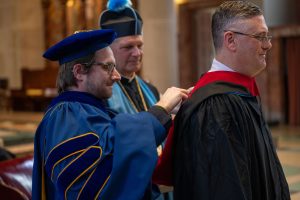
Samuel B. Johnson, Ph.D., hoods a Master’s Degree recipient at graduation in 2025
The collocation of the School of Theology as a distinct yet related Division alongside the Seminary proper signals a shared mission and vision for faith formation in the Archdiocese of Cincinnati. The wisdom and knowledge imparted to seminarians is thus also made available to the faithful at large. For those enrolled in the Graduate Certificate or Master of Arts programs, the courses are the same as those taken by seminarians, meaning that many of our lay students share the same teachers and classroom experiences as the young men who will minister to them from the pulpit and the altar. The ideal of laypersons and future priests accompanying each other as they pursue holiness, each in their own proper vocation, is lived out constantly in our classrooms.
With experts in Biblical Studies and Spirituality, Church History and Philosophy, Literature and Moral Theology, Liturgy and Sacraments, the Faculty of MTSM is well poised to guide all students through the vast riches of the Catholic intellectual tradition. Comprised of both laypersons and priests, our lecturers and professors are dedicated Catholics and excellent teachers, ready to all those who seek to grow in their journey of faith.
As we reflect upon the past fifty years of lay formation in the Archdiocese of Cincinnati, we also look forward to the next fifty years of formation through the School of Theology. All those who have asked themselves what that young woman posed to Fr. Hater in 1975—“How can we help serve the Church?” are invited to explore that question at the School of Theology.
Joey Belleza, STL PhD (Cantab.) is the Director of Programming for the School of Theology and a Lecturer in Theology at MTSM