The Next of Era of Sacred Music at MTSM
The story below was originally published in The Athenaeum, MTSM’s bi-annual magazine. The Athenaeum is published twice a year for alumni, patrons and friends of Mount St. Mary’s Seminary & School of Theology. To be added to the mailing list, contact: Heidi Walsh at 513.233.6159 or hwalsh@athenaeum.edu.
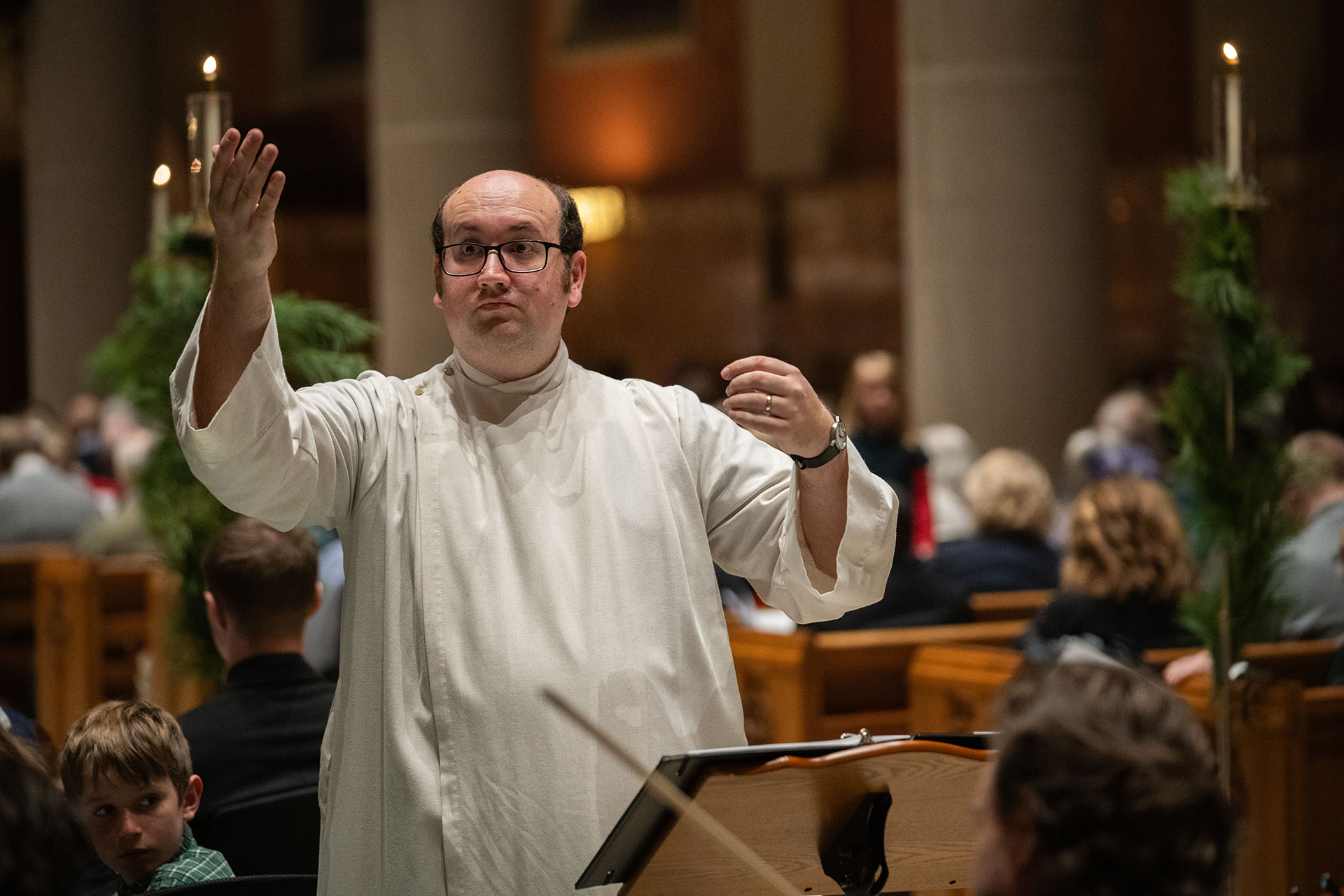
The new Director of Music at MTSM, Christopher Holman, DPhil, is not much older than many of the seminarians he now teaches, in the classroom as Assistant Professor of Music or in conducting the Mount St. Mary’s Seminary Latin Schola. Yet before joining the faculty, Dr. Holman had already gained a remarkable understanding of the Church and the vital role sacred music plays in her life.
“My family belonged to a small parish in Illinois, and from an early age I was fascinated by the Liturgy,” Dr. Holman recalled. From the Champaign-Urbana area of Central Illinois, Dr. Holman recalled a formative moment that attracted him to music and its role in the Church.
“When I was 11 or 12, our family took a vacation to Chicago and we went to Mass at Holy Name Cathedral,” Dr. Holman said. “It was the first time I heard truly great sacred music, the choir sang Palestrina, and the organist played Bach. As we were leaving, I saw a man in a cassock with red piping greeting people on the steps. I asked him about the music and he directed me to the Vatican’s website for documents on the liturgy. I looked them up and then went to the public library to check out as many CDs as I could find with the music. It was only several years later that I realized the man in the rather striking cassock was in fact one of the great supporters of sacred music in the world at that time, (Francis) Cardinal George.”
While an undergraduate at the University of Illinois, Dr. Holman pursued a double major in organ and voice. His time there deepened both his music and theological formation.
“I got involved in the Newman Center and a typical weekend had me playing in three or four churches, each of a different denomination,” Dr. Holman remembered. “It was a fascinating theological education, as I regularly heard three or four different sermons on the same text. Through it all, Catholicism remained the pinnacle and the love of that music never left.
“When I was completing my degree I realized that I had become accomplished at both organ and as a singer, but to go deeper, I would have to choose one path,” Dr. Holman continued. “I chose the organ. I never regret that, knowing how the voice functions is essential to working with the seminarians. They come with a full range of singing experience, from none at all to extensive training.”
That choice of the organ led him to the University of Houston to study with renowned organist and Renaissance scholar Robert Bates, Ph.D. His time there also brought a connection to a name familiar to MTSM.
“Several major institutions in Houston had recently commissioned landmark new pipe organs,” Dr. Holman recalled. “The most notable of those was at the Co-Cathedral of the Sacred Heart, built by Martin Pasi, who crafted our organ at MTSM. The Co-Cathedral organ was where I played my master’s recital. Martin had built a second organ in Houston at a Lutheran parish; that instrument is equally beautiful, but built in a completely different style. I found it so inspiring when I started a concert series there through the university and made a recording on it. Now at MTSM, I have the tremendous joy of playing another of Martin’s wonderful instruments every day — a gift I ascribe to Divine Providence.”
Dr. Holman earned a Frank Huntington Beebe Fellowship that got him the opportunity to move to Basel, Switzerland and enroll at the Schola Cantorum Basiliensis, where he received a Master’s in Specialized Music Performance. It turned out to be a very eye-opening part of his journey.
“In addition to academic research on late Medieval and early Renaissance manuscripts, I was playing concerts every week or two in a different country,” Dr. Holman said. “Those recitals were an astonishing and humbling education — one that no textbook could provide.”
Dr. Holman’s education was unconventional, having completed a Fellowship before receiving his doctorate. Because of that, he still had one more educational path to go down, which led him to the University of Oxford. While at Oxford completing his Doctor of Philosophy Degree in Music, he also served as Director of Exeter College at Oxford, the first American to direct a University of Oxford choir in the nearly 1,000-year history of the institution and was Lecturer in Organ History at the University’s Betts Centre for Organ Studies.
Upon completion, Dr. Holman returned to America and arrived in Cincinnati to serve as the Director of Music at St. Gertrude in Madeira.
“I loved the opportunity to work at St. Gertrude, it kept me grounded in the day-to-day reality of parish ministry,” Dr. Holman noted. “Returning to academic life here allows me to bring that experience into the world of study and formation.”
As he nears the end of his first semester on the faculty at MTSM, Dr. Holman continues to develop his role in the formation process for the seminarians, in the Archdiocese of Cincinnati and where those cross paths.
“I am working very hard to equip the seminarians with the skills they need; and when those skills are united with theology and formation, the results are profound,” Dr. Holman said. “My hope is that our future priests understand sacred music is not a decoration for worship, but something that is intrinsic to the liturgy – something that draws the heart and mind heavenward in a way words alone cannot. I am grateful and proud that we have many wonderful resources here to help with that. Our Chorale and Latin Schola especially give tangible witness to that living history: they show that the Church’s musical heritage is not a museum piece, but a living, breathing apostolate that can help transform the world.”